



In this blog
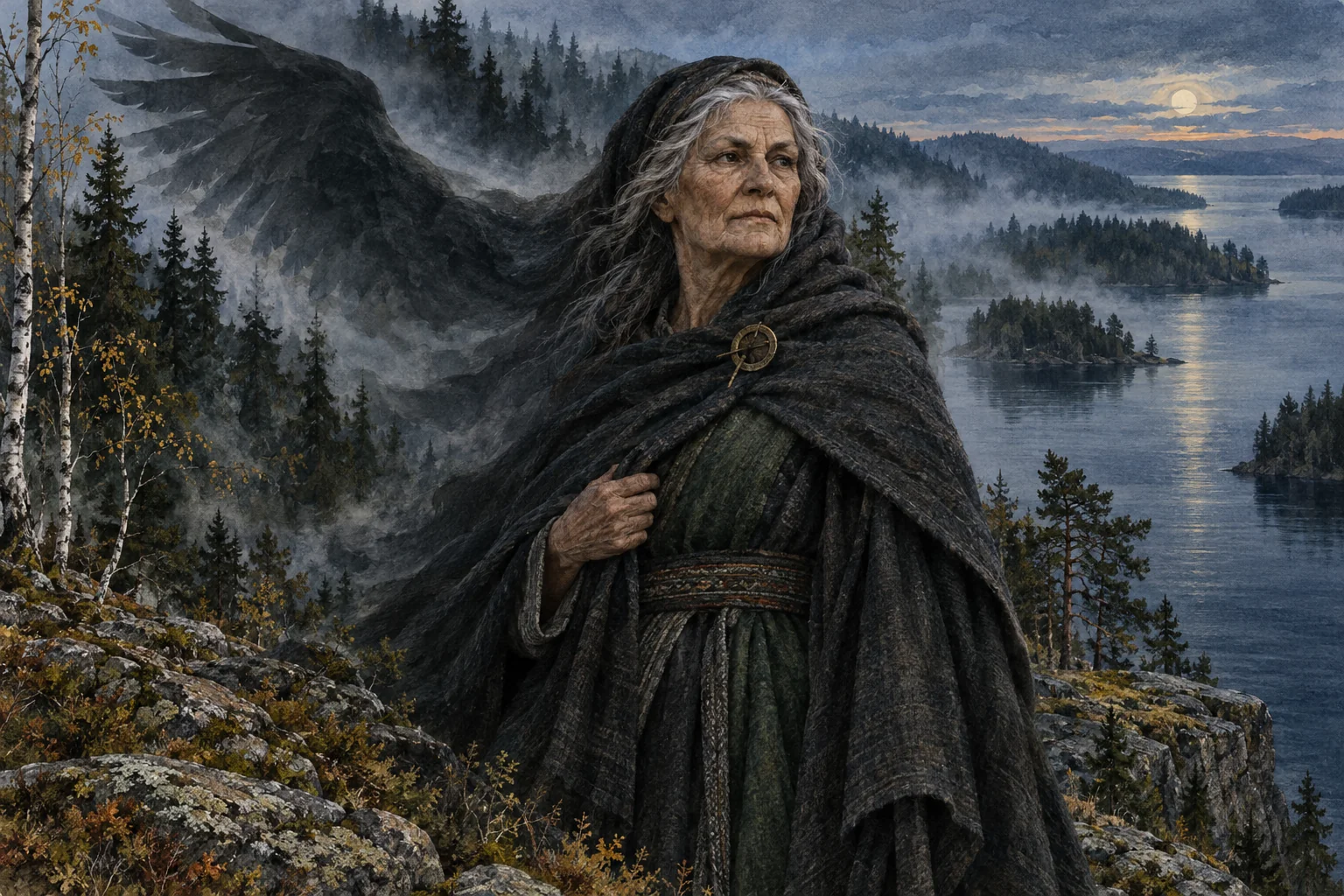
Imagine sitting by the lake in the evening. A little mist hangs over the water, and the forest on the far shore is slowly growing dark. This would be a good moment for a story. One with magic, a precious treasure and a woman who can even turn into a giant eagle.
This woman is called Louhi. In the old stories of the Kalevala, she is the mistress of Pohjola, a mysterious land in the north.
A Woman with Powerful Magic
You can picture Louhi as an older woman, clever and determined. She rules her own land and possesses powers that no one should take lightly. Anyone who wants something from her must negotiate with her. And Louhi sometimes asks for things that seem almost impossible.
Many men come to Pohjola because they want to marry one of her daughters. One of them is Ilmarinen, an exceptionally skilled smith. He can create the most astonishing things from metal.
Louhi asks him for a special treasure: the Sampo.
A Treasure That Feeds Everyone
Exactly what the Sampo is remains something of a mystery. For our story, you can imagine it as a magic mill. A mill that produces flour, salt and money. Whoever owns it has enough to eat and can become wealthy.
Ilmarinen achieves the almost impossible. He forges the Sampo for Louhi, hoping to be allowed to marry her daughter.
The treasure now belongs to Pohjola. Louhi has it kept safe. You can imagine how precious something must be if it can provide for an entire land.
But eventually, others want a share of this wealth too.
The Night the Sampo Disappears
A wise singer named Väinämöinen sets off to see Louhi with Ilmarinen and another companion. The men want to share the Sampo with her. Louhi refuses.
So they decide to take it away.
Väinämöinen plays his kantele, a Finnish stringed instrument. His music is so powerful that the people of Pohjola fall asleep. Once everything has fallen silent, the men take the Sampo from its hiding place and carry it onto their boat.
Then they sail away.
When Louhi wakes, her treasure is gone.
At this point, it is quite easy to understand her anger. The men who appear as heroes in the story have stolen something from her. Louhi wants it back. And she has the power to follow them.
A Giant Eagle above the Water
Louhi sets off in pursuit. When her ship breaks apart, she does not give up. She turns into an enormous eagle and flies after the men.
Imagine the scene: below, the little boat on the wide expanse of water; above it, a huge bird coming closer and closer.
Louhi reaches the boat. She grabs for the Sampo. A struggle begins, and disaster strikes: the treasure falls into the water and breaks apart.
Part of it sinks into the depths. Other pieces later wash ashore. Väinämöinen gathers them up and hopes they will still bring good fortune and prosperity to his land. Louhi is left with only a small fragment of the lid.
No one gets the whole magic mill back.
When Even the Sun and Moon Disappear
The stories of Louhi are far from over.
In another tale, she captures the sun and moon and hides them inside a mountain. The world becomes dark. She also takes fire away from the people.
The smith tries to create new lights for the sky. But his sun and moon remain cold and give no light. Real light cannot be replaced so easily.
Only later does Louhi release the captive lights of the sky, when she fears for her own safety.
Louhi can therefore do far more than defend her possessions. Her anger can cause others great suffering. That is precisely why she stays in our memory: we can understand her one moment and fear her the next.
How We Know Louhi
Louhi's stories are told in the Kalevala, Finland's national epic. It is a large book full of old tales, songs and stories of magic. In the nineteenth century, Elias Lönnrot compiled and edited it from Finnish and Karelian poetry passed down by word of mouth.
Pohjola belongs to this world of legends. You will not find it on any map as Louhi's realm. Even if we imagine snowy forests and dark lakes as we read, it does not refer to a particular place in present-day Lapland.
But perhaps that is part of the beauty of such stories: they need no signpost. A quiet evening and a little imagination are enough.
When you sit at Mökki Tikka by Koirajärvi and look out over the water, you can follow Louhi on her journey in your imagination. And if a large bird appears in the sky, perhaps you will think of the woman who would not give up her treasure at any price.
Further Reading
This is a free, simplified retelling of selected episodes. The story of the Sampo and Louhi's pursuit can be found in cantos 42 and 43 of the Kalevala, and the story of the sun and moon in cantos 47 to 49.
The cabinExperiences & regionJournal